The Church, Moral Truth, and Why Christ, Not Politics Is Our Ultimate Authority in a Divided World
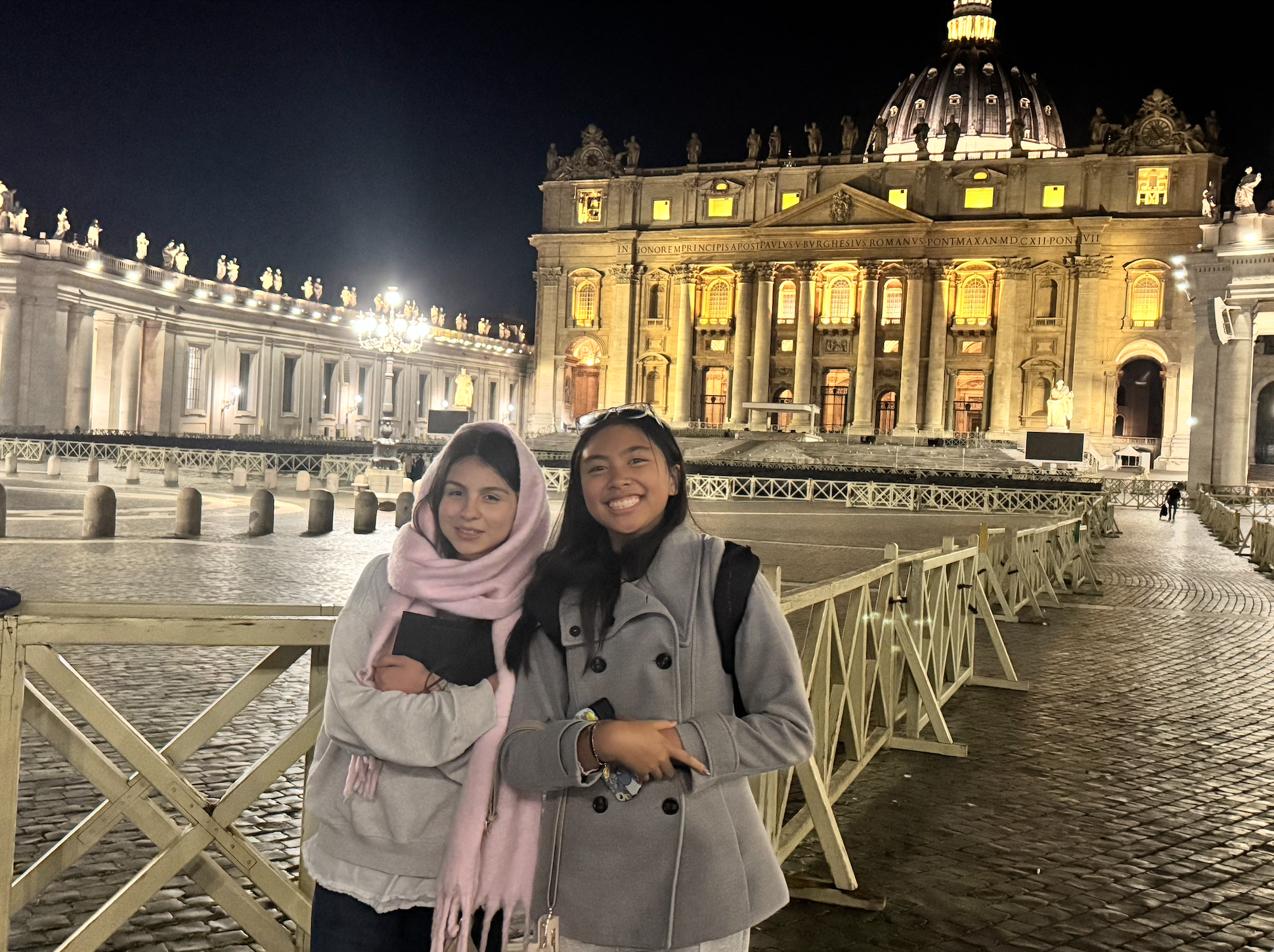
My daughter Sofia-Elisabeth and I recently had the opportunity to visit Rome. The original purpose of the trip was simple and personal, it was an advance gift from my wife and me as she finishes middle school and prepares to enter high school next year, and also to join her friend Sofia-Guadalupe, who was celebrating her 15th birthday in Italy.
Instead of a traditional celebration, Sofia Guadalupe chose something different, a holy pilgrimage with her father, Alex, who is also my good friend and brother in our CFC Community and St. Vincent Ferrer Parish. In a simple act of friendship and faith, she also invited my daughter to join.
Though the decision came together at the last minute, we initially hesitated, especially with the uncertainty of expenses while I was unemployed. But after speaking with my wife, considering the little savings we had, recognizing the blessings we were receiving, and spending time in prayer and discernment, we felt called to say yes. It was also deeply meaningful for us that our daughter Sofia could journey alongside her friend in such a special pilgrimage. And for me, it was not a difficult decision, knowing I would be walking this journey with Alex as well.
In the end, we witnessed God’s providence in remarkable ways, affordable flights, unexpected provision for accommodation, and everything seemed to fall into place along the way.
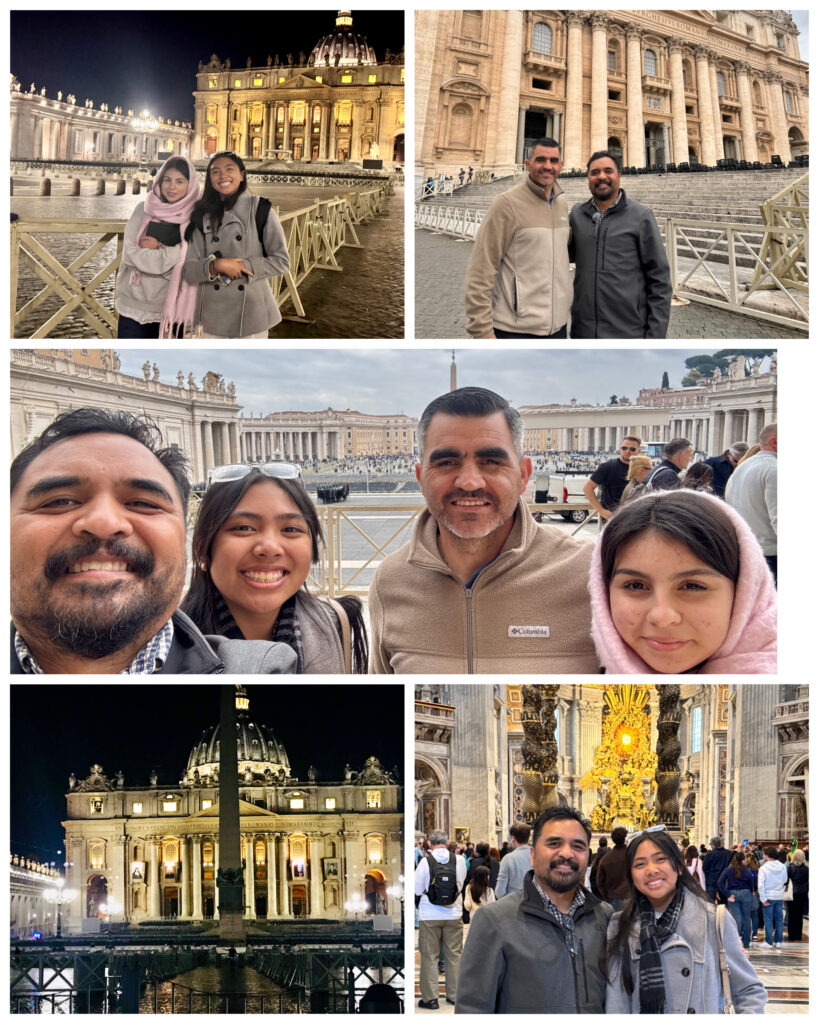
Memories in St. Peter’s Square with the Aceves, Alex, Sofia Guadalupe, and our Sofia Elisabeth.
When we finally arrived in Rome and entered the Basilica of St. Peter at the Vatican, something deeper just started to sink in.
Standing in that sacred space, the heart of the Catholic Church, we were reminded that what we were seeing was not just history or architecture, but something living. A Church that has endured through centuries, through saints and sinners, through triumph and trial, yet still stands as a visible sign of Christ’s presence in the world.
It was in that moment that a deeper reflection began to take shape, not just about where we were, but about what the Church truly is, and what it means for us today.
This is the Catholic Church, the Church established by Jesus Christ Himself when He said to Peter: “You are Peter, and upon this rock I will build my Church, and the gates of the netherworld shall not prevail against it” (Matthew 16:18).
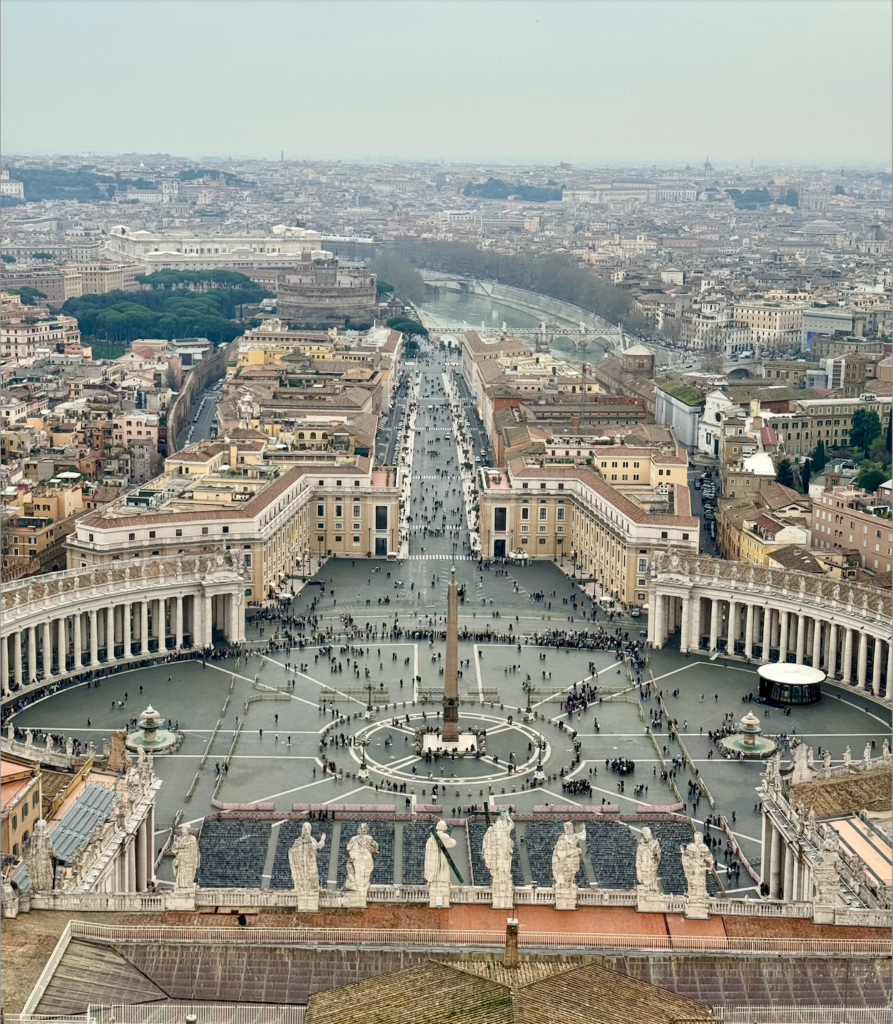
St. Peter’s Square- taken from the top of the dome of St. Peter’s Basilica.
From the time of St. Peter and the Apostles, the Church has remained faithful to what she has always taught. Across two thousand years, she has never changed, contradicted, abandoned, or reversed her teachings. There have been weak popes, sinful leaders, and even scandalous moments in history, but the Church herself, in her teachings, has remained holy, protected, and consistent.
This is the mystery and the promise of Christ.
Kingdoms have risen and fallen. Nations have flourished and collapsed. Political systems have come and gone.
But the Church remains.
Why? Because her teachings are not merely human, they are the teachings of Christ. As Scripture tells us, the Church is “the pillar and foundation of truth” (1 Timothy 3:15), entrusted with guarding the deposit of faith (1 Timothy 6:20) and faithfully handing on what has been received (2 Thessalonians 2:15).
And she does not stand on human strength alone.
The Holy Spirit is the very life of the Church, her sustaining power. As the soul gives life to the body, so the Holy Spirit gives life to the Church. If the soul leaves the body, the body dies. But the Holy Spirit never leaves the Church. Therefore, she will never fall apart, never die. She will endure until the end of time and beyond. Christ Himself has promised it: the gates of hell shall not prevail against her.
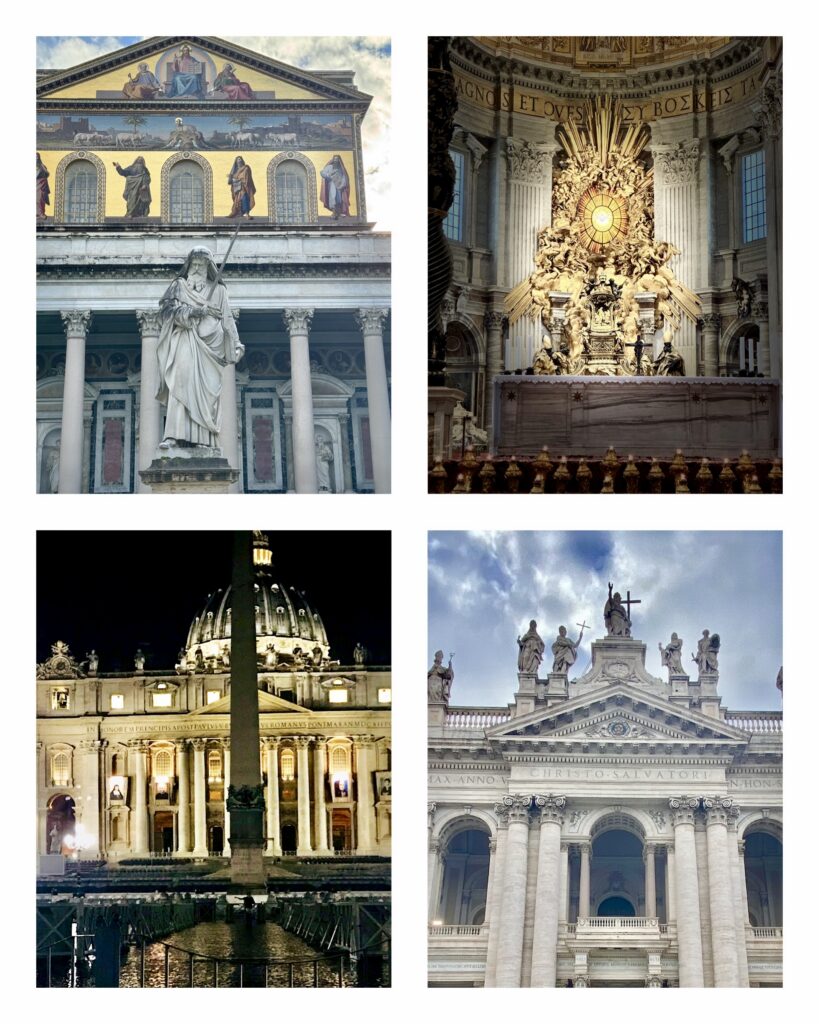
Walking through St. Paul Outside the Walls, Archbasilica of St. John Lateran and St. Peter’s Basilica- from the great basilicas of Rome to the radiant Dove of the Holy Spirit above the Chair of St. Peter.
The Church and Moral Truth in the World
The word Catholic means universal, for all people, in all places, at all times (cf. CCC 830- 831). That is why the Church does not speak only to private spirituality, but also to the moral life of society.
The Church is the guardian of moral truth. Because of this, she naturally has a role in shaping the moral framework that underlies laws and public life.
When Jesus said, “Render therefore to Caesar the things that are Caesar’s, and to God the things that are God’s” (Matthew 22:21), He was not separating God from public life. He was placing Caesar under God.
The state has authority over temporal matters, but God has authority over all things, including the state. When societies attempt to govern without reference to God, confusion and disorder inevitably follow.
This is why the Church has not only a right, but a duty, to speak on moral issues that affect society. As Gaudium et Spes teaches, the Church must engage the world and interpret the signs of the times in the light of the Gospel.
Human dignity, human rights, justice, and peace are not invented by governments, they are rooted in God. They flow from the natural law and are expressed clearly in the Ten Commandments and the teachings of Christ (cf. CCC 1954- 1960; Gaudium et Spes 26).
When people say, “Keep religion out of politics,” they often overlook the fact that many of the very principles that uphold society, human dignity, justice, equality, are grounded in these moral truths.
The Church, therefore, helps form consciences. She guides the faithful in making moral decisions in public life, decisions concerning life, marriage, the poor, justice, and even war. Even in times of conflict, the Church calls nations to moral accountability, reminding us that peace is not optional and that human dignity must never be abandoned (cf. CCC 2301- 2317).
Especially in light of the war in the Middle East and other global conflicts, when the Church, including the Pope, speaks strongly about the immorality of war, he is not expressing a private political opinion. He is exercising the Church’s moral teaching authority, which is rooted in Christ Himself, the true Word of God. Who reveals the fullness of truth.
This teaching on peace and war draws from Sacred Scripture, the natural law written in the human heart, and the Gospel command to love one’s neighbor, as expressed in Gaudium et Spes and the Catechism (CCC 2307–2317 on peace and just war principles).
However, it is important to understand the distinction the Church herself makes: only when the Pope speaks ex cathedra, defining a doctrine of faith or morals to be held by the whole Church, is he preserved from error by the charism of infallibility (cf. Vatican I, Pastor Aeternus, CCC 891).
Even so, the Church’s ordinary magisterium in moral matters is moral teaching authority remains real and binding in conscience according to its level of teaching.
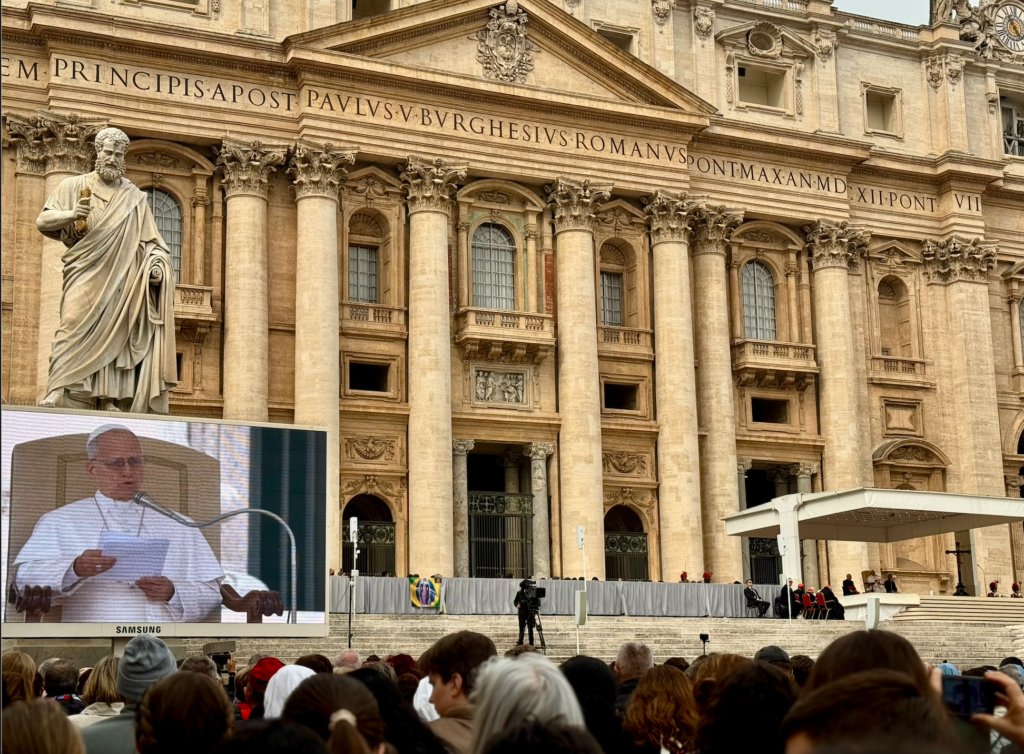
Pope Leo, during his Wednesday papal audience held in St. Peter’s Square outside St. Peter’s Basilica.
When Politics Replaces Faith
And yet, today, many Christians have reversed this order.
Too many see themselves first as “conservative” or “progressive,” and only secondarily as Catholic. They allow politics to shape their religion instead of allowing their faith to shape their politics. They begin to look at Christ through the lens of Caesar rather than judging Caesar by the truth of Christ.
Many Christians today are more passionate about politics than about their faith.
Politics becomes their religion. Their “Caesar”- whether a party, ideology, or personal preference, becomes their highest authority. And when that happens, they lose the ability to challenge it. They no longer ask:
What does my Lord say about this?
Instead, truth becomes filtered through preference.
But Catholic Christians are not left without guidance.
Christ has given His authority to His Apostles and their successors, to the bishops and the pope, to teach in His name (cf. Matthew 16:18- 19; Luke 10:16). This authority does not depend on the personal holiness of the leaders. Just as Judas was chosen as an apostle despite his betrayal, so too God works through imperfect instruments. He has not left truth to our private judgment alone, but entrusted it to a visible, public, universal Church.
Truth, Unity, and Division
Throughout history, there have been good shepherds and bad shepherds. As the prophet Jeremiah warns, bad shepherds mislead and divide (cf. Jeremiah 23:1-4). They fail to teach the truth fully, and as a result, division follows.
Truth unites. Error divides.
What we see today, division, polarization, mistrust, is not only in the world but often within the Church herself. And much of this division reflects the world’s divisions.
But the answer is not to abandon truth, it is to return to it.
Even the categories we use “conservative” and “progressive” can be properly understood. Roots and fruits need each other. Tradition and growth are not enemies. Without roots, there are no fruits. Without fruits, the roots have no purpose.
We are called not to ideological camps, but to communion in truth.
The Christian in the World
Christianity does not ignore politics, but it puts it in its proper place.
There are real social and political sins, and we are responsible for addressing them. But these are not merely violations of ideology, they are sins against persons, against our neighbor, and against God.
Politics exists to serve the human person, not the other way around.
As St. Paul reminds us: “Do not be conformed to this world, but be transformed by the renewal of your mind” (Romans 12:2).
The Church brings moral clarity where the world often brings confusion. When politics is separated from morality, society descends into disorder. But when politics is guided by truth, justice can flourish.
Where We Belong
In the end, the question is not simply political.
It is spiritual.
Who do we belong to?
Not to a party. Not to an ideology. Not to Caesar.
We belong to Christ.
And our Lord is not defined by the symbols of political power- the donkey or the elephant.
He is the Lamb of God, who takes away the sins of the world (cf. John 1:29; Revelation 5:12).
So, in the end, our allegiance is not to any earthly power, ideology, or passing kingdom, but to the One who gave His life for the salvation of the world.
Everything else passes, but the Lamb remains.
And those who belong to Him will not be lost.
History will remember its kingdom, but eternity belongs to Christ.
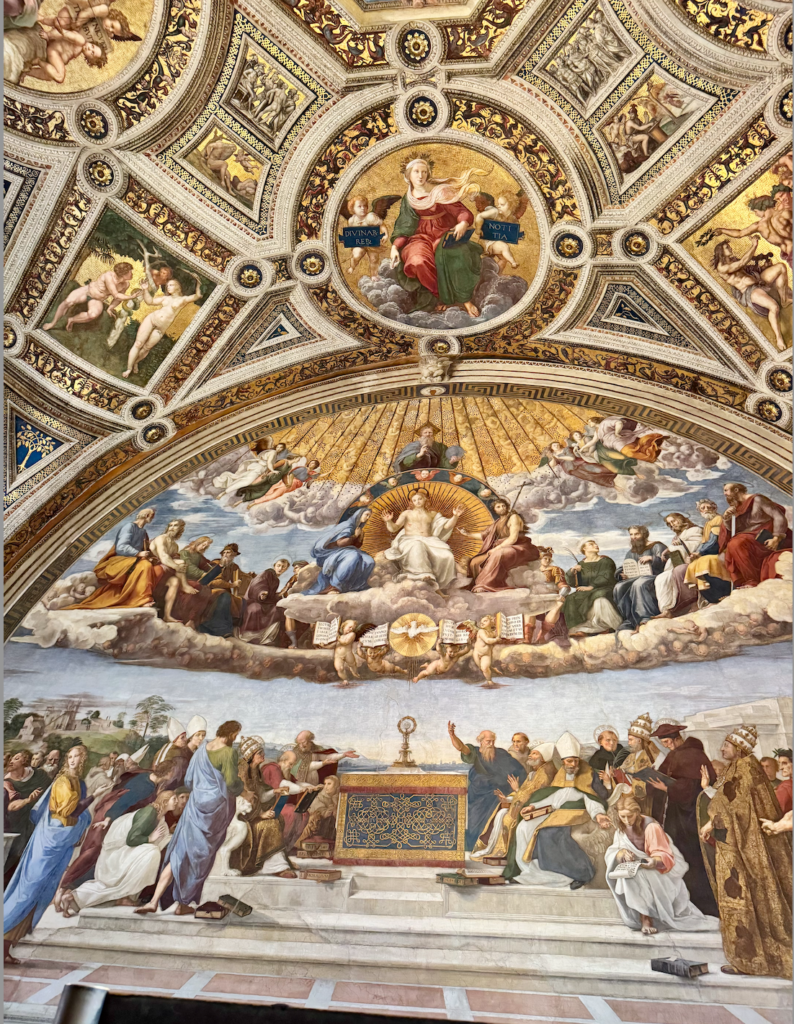
Inside the Vatican Museums, a glimpse of the fresco The Triumph of the Church
Leave a Reply