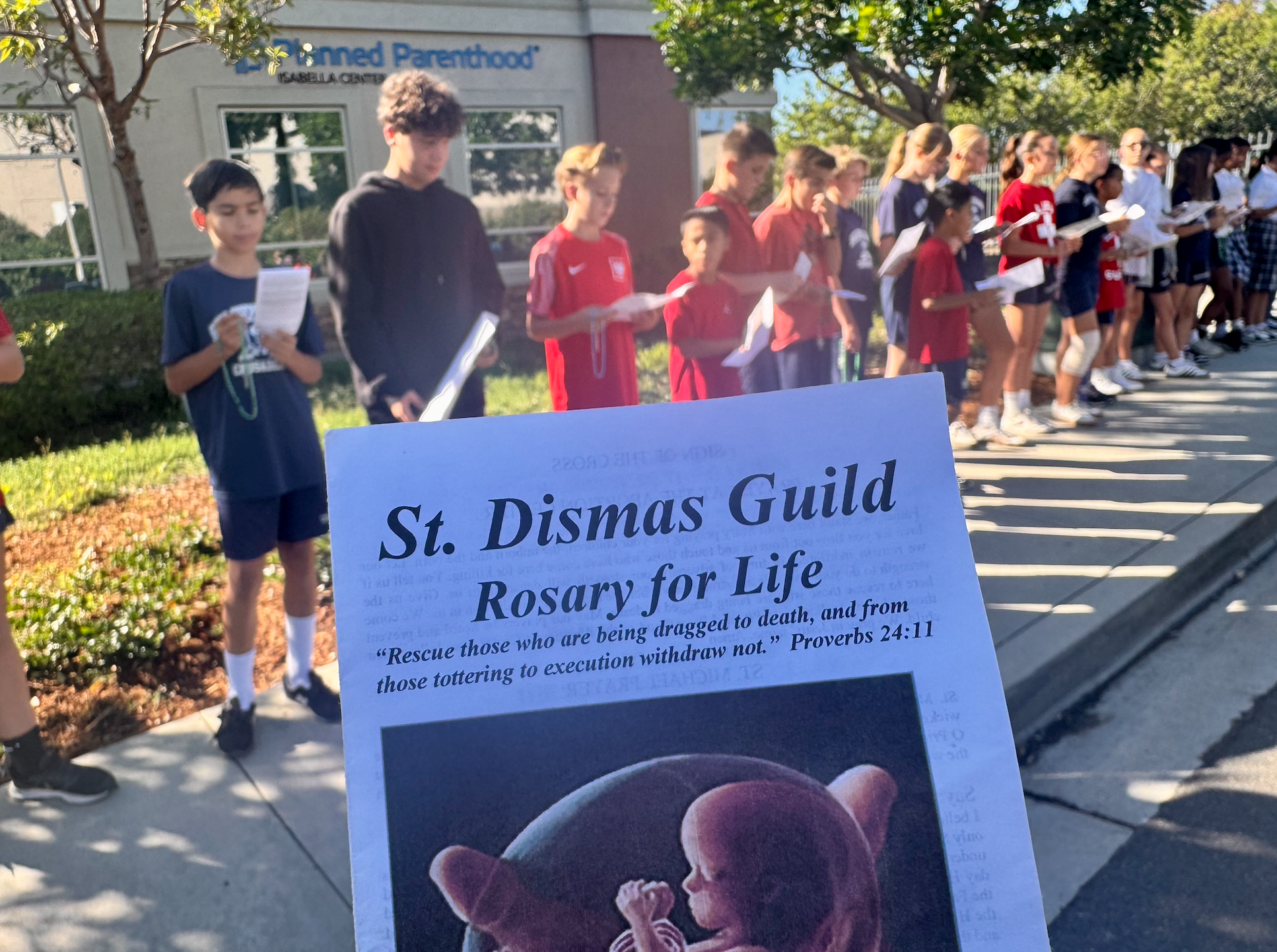
Today, I participated in the Pro-Life Day with St. Joseph Academy for the first time. Even before I became part of this community, I had already admired how active and unapologetically Catholic and pro-life the school was. Friends had told me how deeply involved the community was in defending the unborn, whether by speaking up for the dignity of every human life or by praying outside abortion clinics.
Today, I was thrilled to join our middle school students, from sixth through eighth grade, along with my wonderful co- teachers and several parents who helped transport the students to a nearby Planned Parenthood facility. There, we gathered to pray the Holy Rosary for the protection of the unborn and the dignity of every human life.
However, the experience turned out to be quite different from what many of our students had expected.
According to several students, this year was different. In previous years, people would yell at the students as they passed by, but today, some women who opposed our pro-life witness actively confronted us and tried to disrupt our prayers. One of them filmed us, livestreamed the gathering, and began shouting and cursing at us. A few minutes later, another woman arrived in a van, parked on the side street directly in front of us, and began blasting loud music through speakers to disrupt our prayer. She also used a megaphone to shout at us, particularly at the teachers and students.
Despite these disruptions, our students continued praying the Rosary. In fact, their voices grew stronger.
Reflecting on what happened today, three things particularly moved me.
First, I witnessed the courage of our students.
Despite the hostility and the attempts to intimidate them, our students persevered in prayer. I could see that some felt uncomfortable and intimidated, which was understandable. Yet they continued praying, refusing to let the disruptions take their attention away from the purpose for which we had gathered.
Jesus tells His disciples, “Blessed are they who are persecuted for the sake of righteousness, for theirs is the kingdom of heaven” (Matthew 5:10). These words took on a more personal meaning for me today. Our students were given an opportunity to experience, in a small but tangible way, what it means to stand firm in their convictions when doing so is not welcomed by everyone.
Second, I witnessed the grace of God at work in our response.
Some of us teachers and parents were filmed from very close range, even directly in our faces. Yet, by God’s grace, we remained calm and continued praying. We did not need to respond with hostility or return insult for insult.
One of our eighth graders spoke about the experience afterward and said that we should always “kill these mean people with kindness.” That comment truly moved me.
What a beautiful lesson for all of us! Our Christian witness must not only defend the dignity of the unborn; it must also recognize the dignity of every person, including those who disagree with us or treat us unkindly.
As St. Paul reminds us, “Do not be conquered by evil but conquer evil with good” (Romans 12:21). This does not mean compromising the truth or remaining silent about the sanctity of human life. Rather, it means standing firmly for what is right while refusing to surrender charity. We are called to defend life without forgetting that every human person, including those who oppose us, is created in the image and likeness of God.
Third, I witnessed a powerful example of courage and perseverance in our students’ prayer.
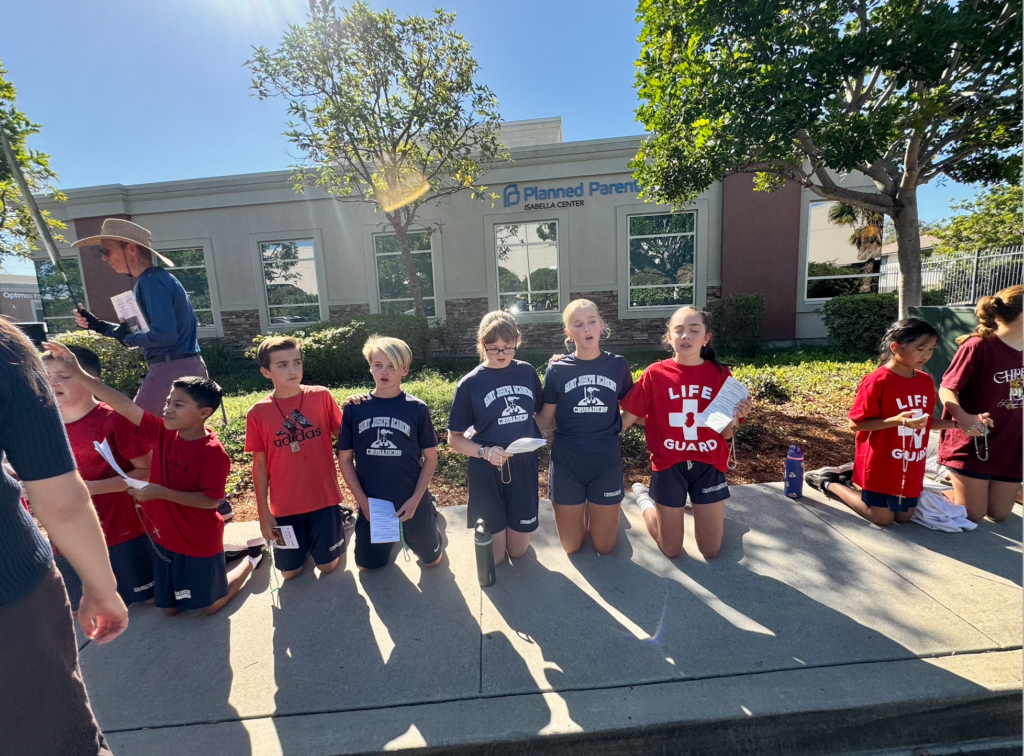
As the Rosary continued, the disruptions grew louder. Another woman arrived with a large speaker and began playing loud music as well. Yet our students remained composed and prayerful, raising their voices to continue the prayers. Then, several seventh graders initiated something that particularly struck me: they knelt down to pray, and the others followed.
Seeing them kneel and continue praying made me reflect on the concept of “white martyrdom.”
In Catholic tradition, white martyrdom refers to a form of witness to Christ that involves enduring hardship, sacrifice, rejection, or persecution without being killed for the faith. The word martyr comes from the Greek word for “witness.” While red martyrdom refers to witnessing to Christ even unto death, white martyrdom is often used to describe a life of faithful perseverance and sacrifice amid suffering and opposition. 1
St. Jerome, reflecting on the spiritual sacrifices of a devout Christian life, wrote that “the spotless service of a devout mind is itself a daily martyrdom.” 2 His insight reminds us that the witness of faith is not limited to those who shed their blood. It can also be expressed through a life of steadfast fidelity to Christ, offered in love and sustained by grace.
St. John the Beloved offers another meaningful example of this witness. According to Christian tradition, St. John endured persecution and exile on the island of Patmos, where he received the visions recorded in the Book of Revelation (Rev. 1:9). Tradition holds that, unlike the other apostles who are traditionally associated with martyrdom, St. John died a natural death.3 For this reason, his life is sometimes associated with the concept of white martyrdom: a life wholly dedicated to Christ, marked by suffering, perseverance, and faithful service. His example reminds us that bearing witness to Christ is not limited to the shedding of blood but can also be expressed through a lifetime of fidelity to Him.
I would not presume to compare what our students experienced today with the sufferings of the saints. Rather, I see in their actions a glimpse of the same spirit of Christian witness: the courage to remain faithful, the willingness to endure discomfort for the sake of what is good, and the grace to respond to hostility with prayer rather than hatred.
Think about it: these were sixth, seventh, and eighth graders. They could have asked us to leave. They could have decided that the confrontation was too uncomfortable and that it was better to stop praying. Instead, they continued. They knelt. They prayed. They were not ashamed to make their faith visible.
Their witness convicted me.
I have participated in many pro-life rallies before, and I have encountered passersby and drivers who disagreed with our position, shouted at us, cursed at us, or made offensive gestures as they passed. But today was different. For me, and especially for many of our sixth graders, this was a first experience of such direct hostility while praying publicly.
And yet, we persevered.
It reminded me that Christian courage does not mean feeling no fear. It means remaining faithful even when we feel afraid, trusting that the Lord will give us the grace we need. As St. Paul writes, “For God did not give us a spirit of cowardice but rather of power and love and self-control” (2 Timothy 1:7).
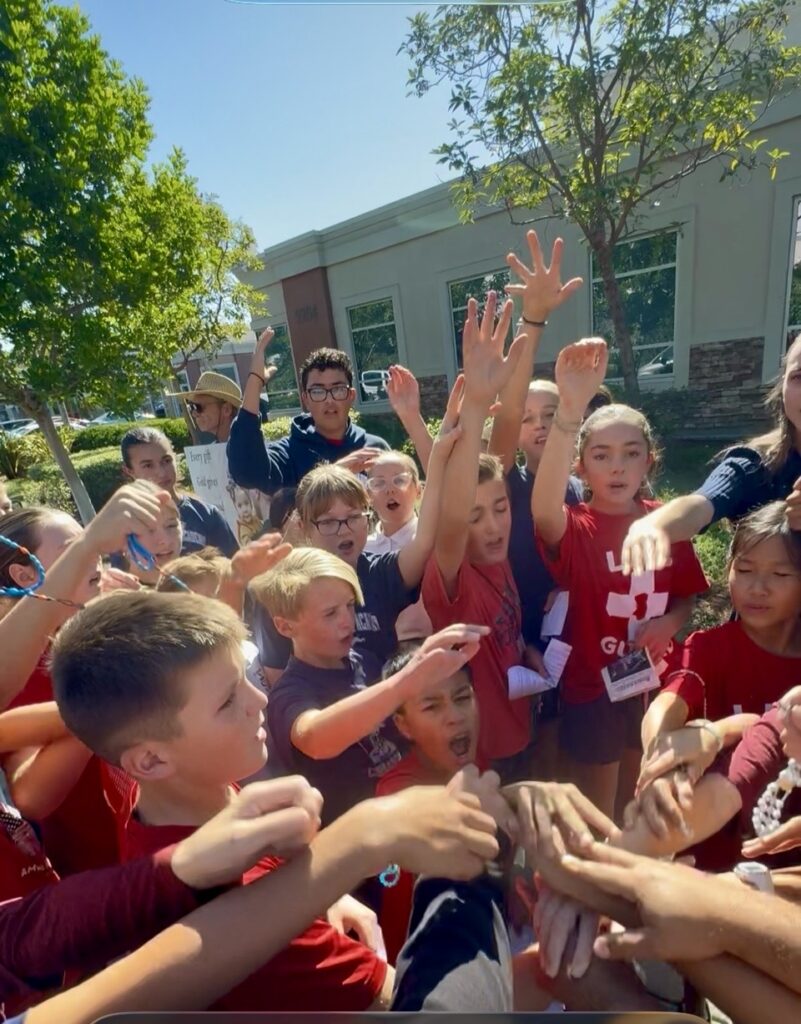
We left the gathering feeling victorious, joyful, and fulfilled, not because we had defeated or humiliated anyone, but because we had remained faithful to our purpose. We had come to pray for the unborn, to bear witness to the dignity of human life, and to entrust every person involved to God’s mercy.
I want to express my gratitude to all our students who participated, especially those who persevered through an uncomfortable and challenging experience. I am grateful to the parents who gave their children permission to attend, to the parents who accompanied us, and to my fellow teachers who helped ensure our students’ safety while joining them in prayer. I also appreciate the students who could not attend in person but prayed for us back at school. We truly felt your prayers!
To our students, especially those who knelt down and continued praying when the situation became more difficult: thank you for reminding us what courageous faith looks like. I had the opportunity to tell you afterward how brave you were and how your witness gave us a glimpse of white martyrdom.
May you never be ashamed of your faith, but may you always remember that true courage must be joined to humility, gentleness, and charity. May you have the conviction to stand for the truth and the wisdom to treat every person with dignity, even when others do not agree with you.
Jesus tells us, “Let your light shine before others, that they may see your good deeds and glorify your heavenly Father”(Matthew 5:16).
Today, our students let that light shine, not through arguments or retaliation, but through their perseverance in prayer.
May the Blessed Virgin Mary, whose Rosary we prayed together, continue to lead us closer to her Son. May St. Joseph, the protector of the Holy Family and patron of our academy, intercede for us. And may the Lord strengthen our entire school community to defend the dignity of every human life with courage, conviction, and Christlike love.
For life. For Truth. For Christ.
Ad Majorem Dei Gloriam – For the Greater Glory of God.
- Notes:
- Catholic Church. Catechism of the Catholic Church. 2nd ed., Libreria Editrice Vaticana, 1997, para. 2473- 2474
↩︎ - Jerome. Letter 108: To Eustochium. Section 31-32. Nicene and Post-Nicene Fathers, edited by Philip Schaff and Henry Wace, 2nd series, vol. 6, Christian Literature Publishing Co., 1893. New Advent, www.newadvent.org/fathers/3001108.htm.
↩︎ - St. John, Apostle and Evangelist,” Vatican News, https://www.vaticannews.va/en/saints/12/27/st–john–apostle-and-evangelist.html.
↩︎

Leave a Reply